

Dubai South’s airport expansion is a significant planning context, but a home still needs to work on its present location, layout and documented ownership costs. Separate existing amenities from future infrastructure, test ordinary journeys and identify the likely occupier. An airport capacity target is neither current residential demand nor a guaranteed property return.
An airport announcement is an impressive way to introduce a property location. It is a less complete way to choose a home. For Dubai South, the investment in Al Maktoum International Airport is clearly relevant, but a household still needs to know where it will shop, how it will travel and what will be ready around its building. An investor needs to identify the occupier rather than assume every person associated with aviation will want the same property. This guide looks at Dubai South through those more specific questions. It uses official infrastructure and developer announcements to establish the direction of development, then separates that direction from outcomes which remain uncertain. We do not publish an unsupported local rent, claim that airport capacity is already operational or treat a historical construction target as a current handover certificate. The objective is to help buyers decide whether a particular part of Dubai South works now, could work later, or still needs evidence before it belongs on a serious shortlist.
The direct answer: what is the buying proposition?
Dubai South offers a residential proposition connected to a wider aviation, logistics and development district. Official airport expansion plans and residential construction announcements support that context. They do not guarantee that every project shares the same access, delivery timetable or tenant appeal. A sensible purchase begins with a defined home and occupier, then tests the actual travel routes, operating facilities and financial commitments attached to it.
This is a location where the word future can do a great deal of work. Used carefully, it describes a planning horizon. Used carelessly, it turns every unresolved detail into an assumed benefit. A buyer should be comfortable saying which parts of the decision depend on facilities already operating and which depend on a later milestone. That division gives the investment case something tangible to stand on.
What the airport evidence establishes
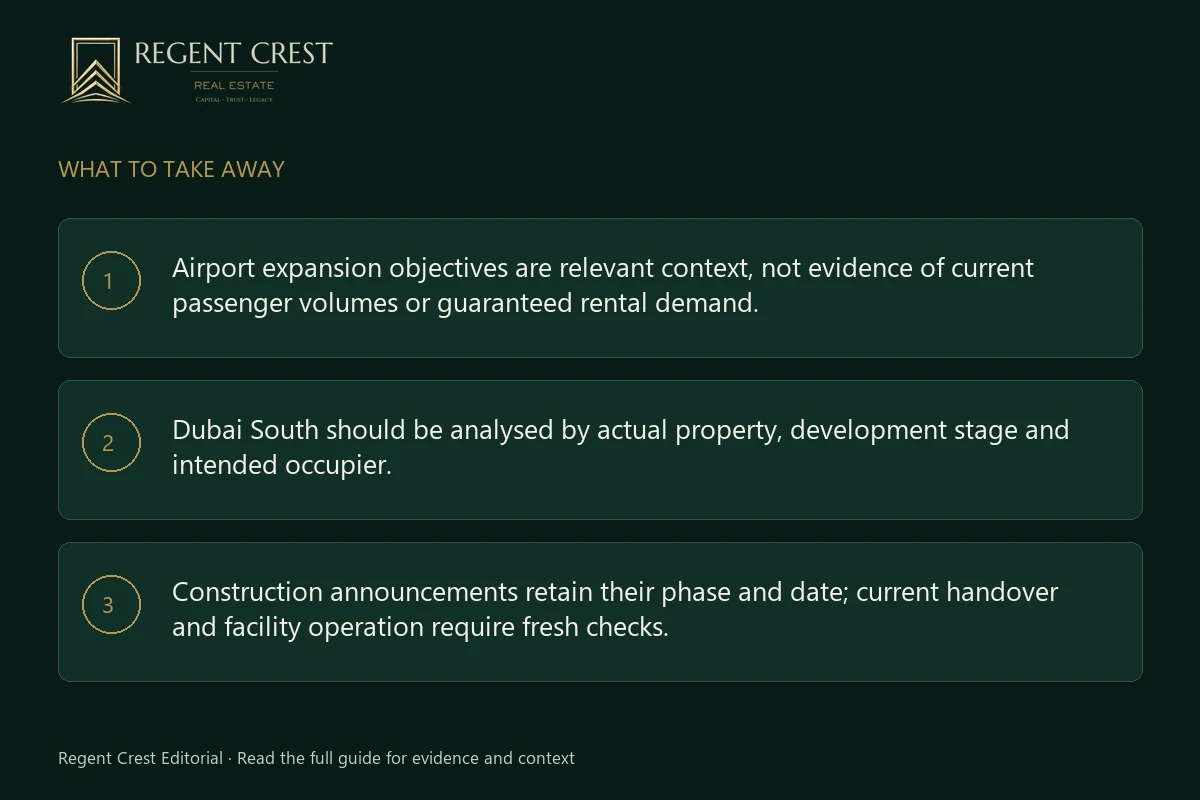
Dubai Airports' 28 April 2024 statement identifies the AED128 billion phase-two expansion of DWC. Its airport background information describes a planned 150 million-passenger facility over the development period and an ultimate capacity of 260 million. These are expansion objectives, not a statement that those passenger volumes are currently being handled.
For property research, distinguish construction investment, operational capacity, employment and housing demand. They are connected, but one does not provide a complete measure of another. A capacity target does not tell us how many households will seek accommodation in a specific neighbourhood, what they can afford or when they will move. Those questions require their own evidence. A robust location thesis should make that chain visible rather than jump from the largest airport number to a rental-yield forecast.
Start with the occupier, not the map boundary
Aviation staff, logistics professionals, families and people working elsewhere in Dubai can have different housing preferences. Some may value proximity to a workplace, while others need a school, a particular room arrangement or access to a partner's job. Avoid treating a broad employment district as one uniform pool of tenants. Identify which group could plausibly choose the property, then ask what competing homes would meet the same need.
An apartment intended for one adult working nearby should be assessed differently from a family townhouse. Storage, parking, outdoor space and quiet working areas can carry different weight. For a family, the ability to make two daily journeys may be more important than being close to one large employer. An investor should be able to describe the likely household in ordinary terms, without inventing a fictional tenant or assuming that a general economic story proves a particular level of rent.
Ask whether the proposed home has a clear reason to be chosen over alternatives at a similar full cost. The answer could be a practical layout, a particular location or a suitable combination of facilities. If the answer is simply that the area is developing, the occupier case is unfinished. Growth can expand the number of available homes as well as the number of people considering them. The relevant balance must be investigated at the segment level.
The district is not a single doorstep
Large-area labels can hide meaningful distances. The route from a building to a major road, a shop or a bus stop may matter as much as the distance across the wider map. Begin at the entrance serving the actual property. Include the internal street pattern, turning arrangements and the return journey. A marketing location pin is a useful orientation tool; it is not a substitute for understanding the last part of a routine trip.
For an end-user, list the journeys repeated every week and compare them with another location. Add the places that are easy to forget during a property visit: a pharmacy, a child activity, a relative's home or the service centre you actually use. This is not an instruction to prefer an established district. It is a way to understand the practical benefits and compromises of an emerging one before the move makes them unavoidable.
People who work irregular hours may have different priorities again. Ask how transport and building access function at those times, rather than assuming the daytime experience represents every shift. If a household expects to rely on public transport, verify the current route, service pattern and access to the stop. Planned transport connections belong in a separate column until the relevant authority confirms operation.
Read residential pipeline announcements as dated evidence
An official Dubai South announcement identifies an AED1.5 billion construction contract for South Bay phases 3,4 and 5 and gives a Q1 2027 target for phase 4. That establishes what was announced; it does not verify the condition of a particular home today. The same page describes planned neighbourhood facilities. Their current operating status should be checked independently before a household bases its move on them.
A pipeline list should retain each project's identity, phase and source date. Separate an announced launch from a construction contract, a reported inspection stage and actual handover. If the name of a phase changes in later documents, record the relationship explicitly. A collection of vaguely dated project names may look comprehensive while providing little useful information about the homes that will compete for an occupier at the time you expect to enter the market.
Do not add every proposed unit in a broad district and call the result immediate supply. Homes can have different types, delivery periods and target households. Conversely, do not ignore nearby projects because their branding differs. The sensible question is which products could be ready, usable and competing for a similar occupier within your intended period. Where the evidence does not support a firm delivery assumption, show a range of scenarios rather than an exact forecast.
What to inspect in a home available now
For an existing home, use the opportunity to observe what a future buyer cannot yet see. Inspect common areas, access routes, refuse arrangements, parking and the condition of the property itself. Ask about maintenance history and any work needed before occupation. Visit the surroundings at a time relevant to your household. If the location feels convenient during a short viewing, test whether that impression survives the actual journeys on which the purchase depends.
Check the practical room arrangement with the household's furniture and routines in mind. A modest difference in usable space may matter more than an attractive district-wide price-per-square-foot comparison. Ask whether external space is private, shared or subject to rules that affect its use. If a home is tenanted, obtain appropriate professional advice about the tenancy and your intended occupation or investment plan. Do not assume that buying a property makes it immediately available for your preferred use.
What changes for an unfinished home
For off-plan purchasing, the relevant evidence moves towards documents, specifications and delivery. Ask for current project information, the unit plan, reservation conditions and the governing contract. Link payment obligations to dates and understand the consequences if the household's circumstances change. Our off-plan project checklist can help organise that conversation without turning the developer's wider district vision into proof about a single unit.
The budget should acknowledge any period in which the household funds the purchase while living elsewhere. A planned rental strategy should not assume income before the home is actually ready for occupation. If the intention is to sell before completion, examine assignment terms and the possibility of holding longer than expected. The location story can be promising while a particular financing or exit arrangement remains unsuitable for the buyer.
Infrastructure can create opportunity and inconvenience together
A growing district can offer improving facilities while also asking early residents to live through construction. These are not mutually exclusive experiences. Request information about nearby development parcels and access changes. Ask which works directly affect the property and which are simply part of a large regional plan. The aim is to understand what the household would encounter during the relevant period, rather than judge the area entirely by either its finished vision or its present incompleteness.
For homes influenced by airport activity, ask the appropriate questions about the location and building specification rather than making assumptions from distance alone. If noise or another environmental condition is material to your choice, seek relevant technical information and professional advice. A map circle is not a technical assessment. Equally, a concern should not be exaggerated into a conclusion about every property in the district without evidence tied to the specific location.
Compare affordability on a complete basis
The cheapest advertised consideration does not necessarily create the lowest practical cost. Add acquisition expenses, financing commitments, recurring charges and any fit-out or transport implications. A larger home farther from a household's existing routine may still be worthwhile, but the travel commitment should be acknowledged. Another home may cost more to acquire while requiring fewer changes to the way the household currently lives. The trade-off is personal and should be assessed explicitly.
For an investor, separate gross rental income from net operating results. Use actual, appropriately comparable rental evidence if available, with dates and enough detail to understand the population. If that evidence has not been gathered, do not insert a community yield from a different provider and treat it as the return on the selected unit. Show assumptions for vacancy, management and maintenance clearly, and examine the result if those assumptions prove less favourable.
A practical way to compare two development stages
Imagine two options without assigning them fictional market numbers. One is available to inspect with its immediate surroundings largely established. The other offers a preferred layout in a later delivery phase. For the first, investigate current condition and the cost of any changes. For the second, investigate the waiting period, commitments and unfinished surroundings. Compare the amount of uncertainty you are accepting as carefully as the amount of space you are buying.
Then ask what would make you regret each choice. Perhaps the established home compromises too much on room use. Perhaps the future home requires a timetable your family cannot manage. This is a useful exercise because it brings the decision back to conditions you can investigate. It also creates a clear basis for walking away. A location does not need to be rejected altogether merely because one particular home is not right for the intended use.
What would strengthen the local demand case?
Evidence of occupier demand should be specific and current. Useful material might include comparable registered rental observations, the characteristics of competing homes and documented information about facilities that affect the intended household. A dated employment announcement may add context, but should not be converted directly into a tenant count. Research is stronger when each piece of evidence has a clearly stated role rather than being assembled as a list of positive headlines.
The Regent Crest buying guide provides a broader framework for comparing quality and suitability. Readers weighing a different lifestyle proposition can also examine our waterfront community guide. The purpose of comparing locations is to identify the home that fits the actual requirement, not to select the largest infrastructure announcement and hope the rest follows.
Where the research leaves a buyer
The official sources support a substantial development direction around aviation and residential delivery. They do not establish a universal rent, guaranteed appreciation or identical convenience across Dubai South. Those outcomes depend on the particular property, its timing and the people expected to use it. Current price and yield figures are intentionally absent here because no suitably verified local comparison set was assembled for this guide.
The next step is to choose a small number of real options and investigate them on the same basis. Define the occupier, test the journeys, identify operating facilities and obtain the relevant documents. Keep future benefits visible without treating them as current services. If you would like help making that comparison, send Regent Crest your household or investment requirements. A useful shortlist should connect the wider Dubai South story with a home that makes sense on an ordinary working day.
Questions answered
Does the airport expansion guarantee a property return?
No. An infrastructure objective does not establish the rent, price or liquidity of a particular home. Those require their own current evidence and an individual assessment.
Are all properties in Dubai South similarly convenient?
No assumption should be made from the area label. Start with the actual building or community entrance and test the journeys that matter to the intended household.
What does the South Bay construction announcement prove?
It documents the named contract and target described by Dubai South at that time. It does not replace a current phase-specific inspection, handover record or contract.
Are rental yields provided here?
No. A verified local rental and ready-property comparison set was not assembled. Inventing a yield would add false precision to an area guide.
How should a buyer compare ready and off-plan options?
Compare current condition and operating surroundings for the ready home with documents, payment timing and delivery uncertainty for the future home. Include the full cost of the waiting period.
Sources and verification
Material claims last reviewed 20 November 2026. Availability, prices and project details can change.
- South Bay phases construction contract — Dubai South · Checked 20 November 2026
- DWC phase-two expansion statement — Dubai Airports · Checked 20 November 2026
- DWC background — Dubai Airports · Checked 20 November 2026
Explore the relevant properties and communities
Apply this research to your property shortlist.
Share your budget, preferred areas and buying timeline. Regent Crest can help you compare the current options and identify the details to verify before you commit.
Discuss your requirement