

A Palm Jebel Ali Frond F villa should be assessed as a particular design on a particular plot. Compare practical access, orientation, privacy, coastal maintenance and the written delivery commitments together. A limited release describes the offering; it does not establish a future resale premium or remove the need to plan for ownership costs.
A beachfront villa can be both a home and a demanding long-term asset. The water may be the reason to look, but it is not the only thing an owner buys. There are rooms to furnish, external spaces to maintain, a delivery process to follow and a substantial amount of capital tied to one property. Palm Jebel Ali FrondF is interesting because its announced release brings genuine architectural variety to that decision. Rather than treating the collection as 44 interchangeable investment units, this guide asks how its designs and setting should be examined by a prospective owner. The official announcement provides a clear basis for identifying the release and its product types. It does not establish the current availability of a particular villa, a binding price or the suitability of the purchase for a particular family. We separate those matters, then explore what a serious comparison should contain before a beachfront image becomes a major financial commitment.
The release, in its correct context
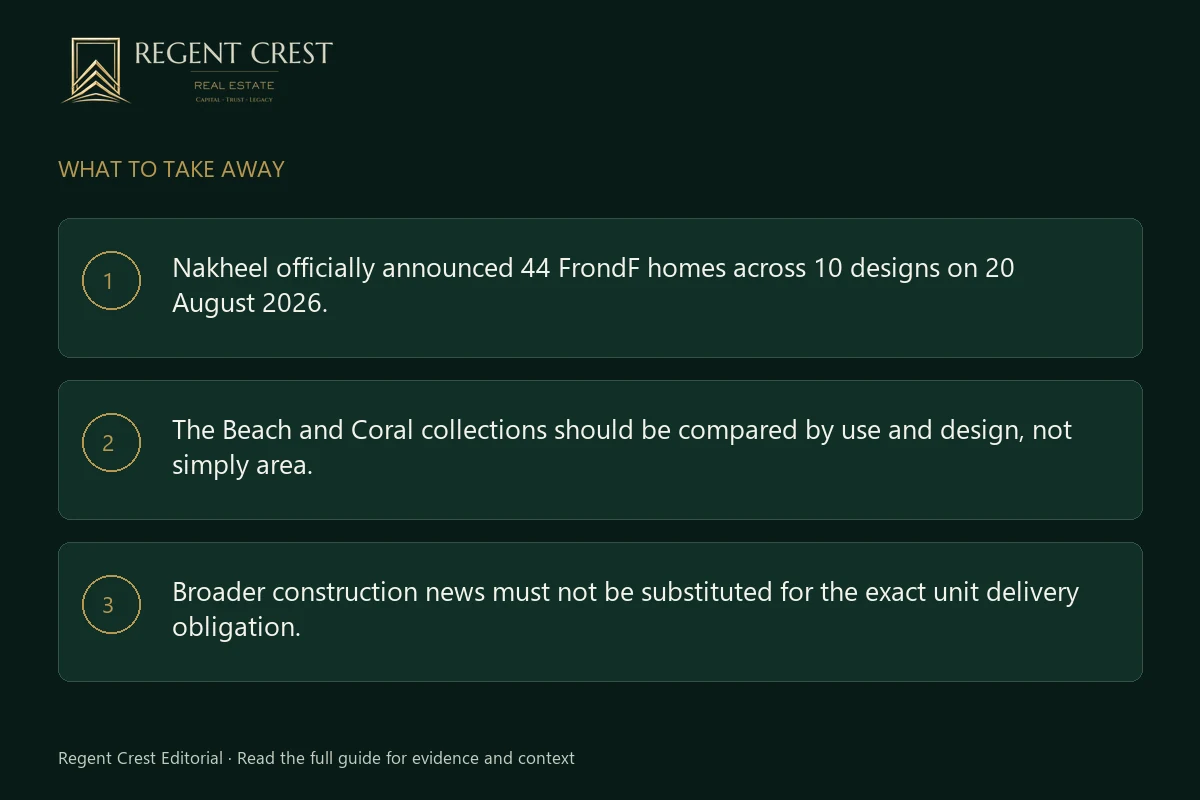
Nakheel's 20 August 2026 announcement identifies 44 beachfront homes on FrondF across 10 architectural designs. The Beach Collection comprises five- and six-bedroom villas, while the Coral Collection includes six- and seven-bedroom homes. Four design practices are named: NAGA Architects, SAOTA, LW Design Group and LOCI Architecture. This verifies an announced collection, not today's remaining stock.
For a prospective buyer, the practical answer is to compare the specific design and plot together, then examine delivery, ownership and exit obligations. Limited release numbers may help describe the offering, but they cannot establish a future resale premium. A home should make sense at the written consideration and on a realistic ownership plan before scarcity language is allowed to influence the decision.
Two collections, more than a size difference
The official announcement places the Beach designs around 7,500–8,500 square feet and the Coral designs around 11,500–12,500 square feet. Those are published collection ranges, not a substitute for the area statement of an individual property. The larger collection should not automatically sit above the smaller one in a buyer's preference order. The question is how much of the extra space serves a real purpose and how the household expects to use it.
Consider the difference between a house intended for frequent guests and one used mainly by a smaller family. Extra entertaining space can be valuable to the first household and largely empty for the second. More bedrooms can support flexibility, but also increase furnishing and operating responsibilities. A comparison should explain who uses each part of the house and how often. Paying for rooms simply because they are available is a different decision from paying for rooms that resolve a clear need.
Architectural character matters too. One buyer may prefer a quieter composition with a direct connection to the garden. Another may want a more sculptural home with separate settings for different activities. Neither taste is inherently more investment-conscious. What matters is understanding how a dramatic form affects usable space, privacy, maintenance access and future adaptability. Design should be evaluated as a living arrangement as well as an image.
The plot and the plan are one choice
A design cannot be assessed independently of its position. Ask for the plot boundaries, the relationship to neighbouring homes and the orientation of the principal living spaces. Look at the depth and shape of the external area, not only the quoted plot size. A long narrow space creates different possibilities from a more regular garden, even if the total area is similar. The route between house, pool and beach should be clear on the drawing.
Privacy is a layered issue. A villa can have an open view to the sea while still needing careful treatment on its sides. Examine upper terraces, bedroom windows and outdoor seating in relation to neighbouring properties. Consider whether the household wants a completely sheltered retreat, a sociable coastal garden or some combination. These preferences can lead to different choices within the same collection, so they should be identified before comparing a general premium for a supposedly superior position.
Ask which elements at the water's edge belong to the property, which form part of shared or managed infrastructure and what access rules apply. This article does not infer private legal rights from a rendering or a phrase such as direct beach access. The current plans and governing documents must establish the relevant arrangements. Where the distinction affects how the property will be used, appropriately qualified legal advice can be more valuable than another round of lifestyle comparisons.
A beautiful interior still needs a working plan
Large homes can contain inefficient space as readily as small ones. Follow an ordinary day from arrival to kitchen, living area and bedrooms. Consider where bags, shoes and sports equipment go, how laundry moves and how private rooms are separated from entertaining. A household that hosts regularly may value a service route that keeps preparation unobtrusive. Another may prefer a more informal arrangement with everyone connected to a single family space.
Check the usability of the bedrooms rather than assuming that a generous total area guarantees each room is comfortable. Locate wardrobes, bathrooms, doors and realistic furniture. Study circulation around stairs and any proposed lift. Ask which provisions are included and which are optional. If a room is expected to change use over time, examine whether its access and shape support that flexibility without substantial reconstruction.
The same scrutiny belongs outside. A terrace can be impressive in an aerial image while exposing little space for shaded everyday use. Ask what is delivered, what landscaping is illustrative and what an owner may alter. Understand the permissions and design rules before budgeting for an outdoor kitchen, additional enclosure or pool changes. The ability to imagine an improvement is not evidence that the improvement is permitted or financially sensible.
Read construction news at the right scale
An official 27 April 2026 contract announcement concerns 544 villas across FrondsA–F. It demonstrates a defined construction programme, but should not be casually converted into the completion promise for every later release. A buyer of one FrondF villa needs the schedule and legal documentation associated with that exact home. Similar place names are not enough to establish identical delivery obligations.
Nakheel also maintains a construction-progress page with separate frond groupings and dated inspection references. A progress percentage should retain its inspection date and scope. It should not be repeated as today's condition without a freshness check, nor applied to a different group because the percentage is more reassuring. Ask for the latest relevant update and match it to the project and unit records under consideration.
There is a useful distinction between a photograph, an inspection-based measure, a contractor milestone and a contractual delivery obligation. Each can contribute evidence, but each answers a different question. A photograph may show visible activity without establishing the completion percentage. A target programme may describe expectations without changing the contract. A careful buyer asks how the pieces fit together rather than allowing any one of them to stand in for all the others.
Plan the house as an operating commitment
The acquisition budget should sit beside an ownership budget. Ask about community charges, external maintenance, pools, landscape care, equipment servicing and insurance requirements. Obtain quotations or qualified estimates appropriate to the particular property rather than importing a generic percentage from another market. Keep recurring costs separate from major replacements and optional lifestyle expenditure. A large home can be affordable to acquire while still requiring a level of attention the owner did not anticipate.
If the property will be used intermittently, explain how it will be looked after between visits. Who checks the home, responds to an issue and arranges access for contractors? How are maintenance records retained? A buyer based abroad should understand these arrangements before completion, not after receiving an urgent call. There is no need to dramatise possible problems; the purpose is to make ownership practical and to identify what professional management would need to cover.
Ask about the specified materials and maintenance approach in the coastal setting. Enquire about warranties, recommended care and access for inspection or repair. Do not assume a premium finish eliminates future upkeep. A well-designed house should have an understandable maintenance story. Where specialist advice is appropriate, include the cost of obtaining it in the buying process rather than treating technical questions as an optional concern after the aesthetic decision is made.
Commissioning and handover deserve a separate allowance of time. An owner may need an independent inspection, a record of outstanding items and a plan for bringing the home into use. Large properties can involve several systems whose operation needs to be understood, from cooling controls to irrigation and pool equipment. Ask for the intended handover information and warranty records. Knowing where the instructions and service contacts sit makes it easier to manage the home consistently, especially if responsibility passes between family members and a professional manager.
Decide who will approve expenditure and keep an accessible record of maintenance work. This may sound administrative beside an architectural discussion, but it protects the experience the buyer is paying for. A house used by different generations or visited intermittently benefits from a clear operating arrangement. Good records also make a future sale easier to explain: another buyer can inspect what has been maintained, rather than relying only on a claim that the property has always been looked after.
Pricing context without an invented starting price
This guide does not publish a current starting price or payment plan because an authenticated unit-specific commercial document was not obtained during the research. A serious comparison begins with a written offer for the exact villa, including its identifiers, areas, consideration and obligations. The price of an earlier release or a different architectural design may offer context, but is not a current quotation. Any such comparison should retain its date and explain material differences.
The meaningful question is what the additional expenditure buys. It may be a different amount of internal space, a preferred orientation, a more suitable garden or a particular design. Write that benefit down. If the premium is justified mainly by a general forecast of appreciation, the buyer has not yet explained why that property is preferable to its alternatives. A luxury purchase can involve taste and enjoyment; those benefits should be acknowledged honestly rather than dressed as a guaranteed financial return.
Scarcity and liquidity are different ideas
A release with a small number of homes can still require patience when an owner wants to sell. The relevant issue is the number of credible buyers for that individual product at the intended price. Architectural individuality may appeal strongly to one purchaser while narrowing the field for another. This is not an argument against distinctive homes. It is a reason to avoid assuming that limited supply automatically means a quick, frictionless exit.
Consider the next owner's likely requirements. Would the design suit a range of households, or depend on a highly personal fit-out? Would a buyer understand the premium without a lengthy explanation? If your strategy relies on selling before completion, examine assignment conditions and the consequences if a buyer does not arrive on schedule. If the intended holding period is long, ensure the property's ongoing use and cost are comfortable without needing an early price increase to make the decision feel successful.
Compare the island home with a genuinely different option
It can be useful to compare a FrondF villa with an apartment-based waterfront product or a mainland family home. The point is to clarify priorities, not to manufacture a like-for-like price ranking. Our Palm Central Private Residences page provides a separate project reference in the wider area. The Palm Jebel Ali location guide offers geographical context. Current offers and rights must still be checked independently for each option.
A household may discover that it values direct access to its own external space more than a particular building amenity. Another may prefer the ease of an apartment and less private maintenance. Both conclusions can be sound. A good comparison makes the trade-off legible and measures the full commitment attached to it. Our waterfront community guide can help organise the lifestyle questions, while off-plan due diligence remains relevant to the future-delivery element.
The final decision should be specific
Before proceeding, assemble the exact design and plot information, current contractual terms, relevant construction evidence and a realistic operating plan. Make sure unresolved matters have been answered in the appropriate document rather than absorbed into a general impression of quality. The buyer should be able to explain why this home, at this commitment, suits the intended household or investment purpose.
FrondF's announced collection offers a credible architectural subject and a clear waterfront proposition. Its 44-home release is a fact about the offering; it is not a forecast. The stronger purchase case will be the one built around a carefully chosen property, manageable obligations and a use that remains worthwhile over time. If you want help comparing the designs and the questions still outstanding, ask Regent Crest for a villa-by-villa review, including the requirements that would make a beachfront home practical for you.
Questions answered
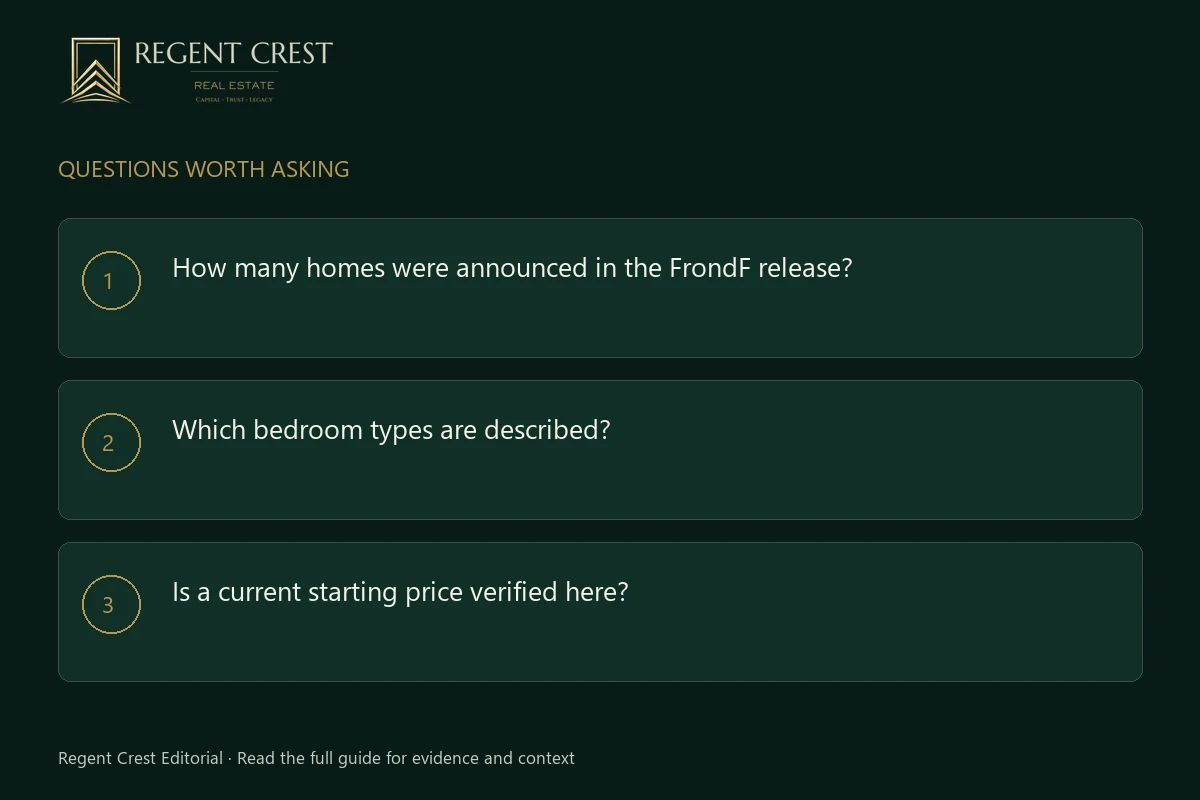
How many homes were announced in the FrondF release?
Nakheel's 20 August 2026 announcement identifies 44 homes across 10 architectural designs. The original release number does not establish current unsold inventory.
Which bedroom types are described?
The Beach Collection includes five- and six-bedroom villas; the Coral Collection includes six- and seven-bedroom homes. Confirm the selected unit plan and area statement separately.
Is a current starting price verified here?
No. An authenticated current unit-specific offer was not obtained, so no price or payment plan is asserted.
Does a construction contract establish my villa handover date?
Not by itself. Match the construction announcement, project records and governing contract to the exact home being purchased.
Does a limited release guarantee an easy resale?
No. Liquidity depends on the credible buyer pool, asking terms and the individual property. Scarcity is not the same as a guaranteed exit or return.
Sources and verification
Material claims last reviewed 19 November 2026. Availability, prices and project details can change.
- Palm Jebel Ali construction progress — Nakheel · Checked 19 November 2026
- 544-villa construction contracts — Dubai Holding · Checked 19 November 2026
- FrondF Beach and Coral release — Nakheel · Checked 19 November 2026
Explore the relevant properties and communities
Apply this research to your property shortlist.
Share your budget, preferred areas and buying timeline. Regent Crest can help you compare the current options and identify the details to verify before you commit.
Discuss your requirement