

RAW District is Imtiaz?s mixed-use project on Sheikh Zayed Road, with an official developer announcement reporting an original launch-day sell-out. Evaluate the exact unit and operating arrangements, distinguish the original development from RAW District II, and establish whether any current offer is developer stock, an assignment or a resale. The historical announcement does not establish present availability or a guaranteed return.
Working close to home sounds simple until the two begin to compete. A shared workspace can be useful, a busy courtyard can make a place feel alive and hospitality services can remove chores. The same features raise questions about quiet, access and cost. That is the interesting part of RAW District by Imtiaz. Its official announcement describes a connected mixed-use proposition rather than an ordinary residential tower with a few extra facilities. For a buyer, the task is to understand how that proposition affects the home being offered. This guide examines the original RAW District, makes the developer's sell-out statement visible and distinguishes the brand from separate later projects. It does not imply that a current unit remains available directly from the developer or that the launch response guarantees future rent. The aim is to help a purchaser evaluate the operating model, the occupier fit and the evidence behind any current offer, with enough distance from launch-day excitement to ask useful questions.
The official position and what it establishes
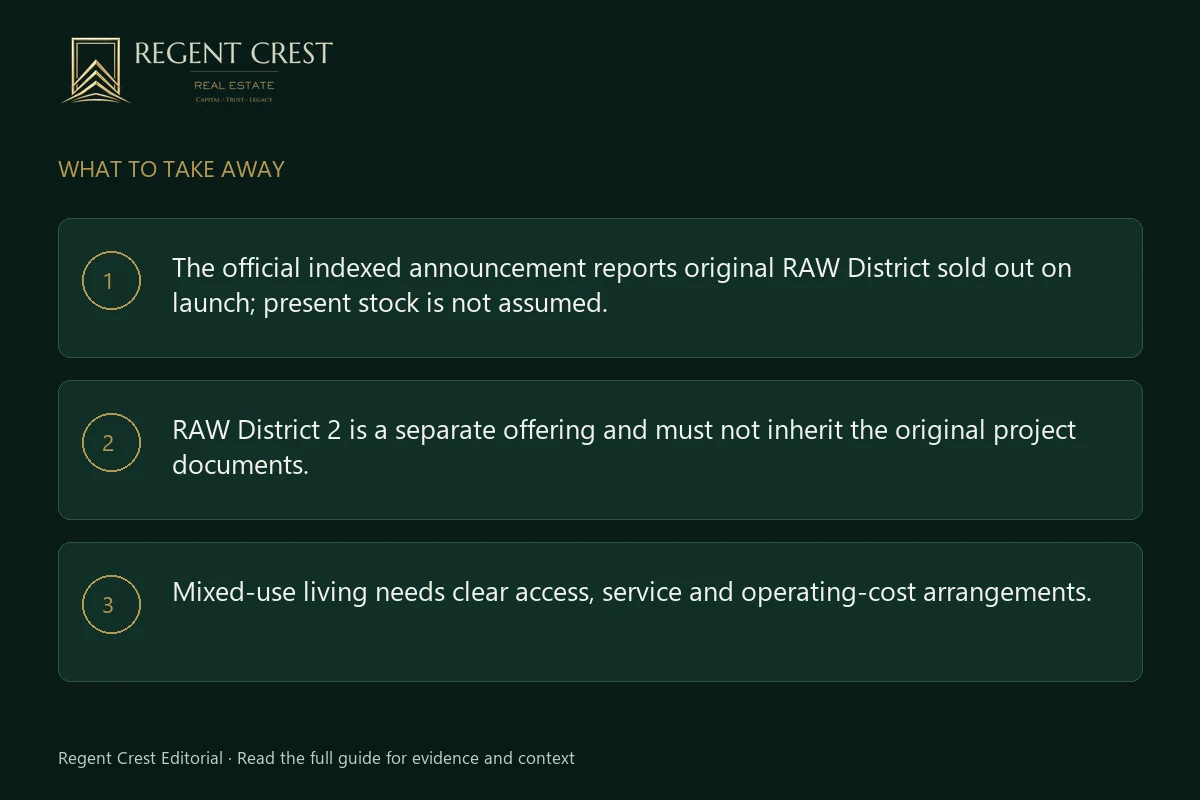
Imtiaz's official sell-out announcement identifies the original RAW District as a mixed-use development on Sheikh Zayed Road and reports that it sold out on its launch day. It describes a combination of serviced residences, offices, co-working, wellness and social uses. The developer's dedicated project page also confirms the RAW identity within its portfolio. These accessible primary pages establish the attributed concept and announcement; they are not an independent audit of today's stock, a binding handover promise or a quotation for a particular unit.
The direct answer for a prospective buyer is to examine RAW as a specific live-work product, with its own documents and management arrangements. Do not infer available developer stock from an older listing. If the offer is a resale or assignment, identify that clearly and investigate the associated terms. A strong launch response can be relevant history while saying little about whether today's price or unit is suitable.
Identify the project before comparing the offer
RAW District and RAW District 2 should not be treated as interchangeable names. Imtiaz's official portfolio separately lists RAW District and RAW District II. A shared concept does not establish identical plans, fees, delivery or legal arrangements. Begin with the exact project and unit identifiers on the offer. Ask which building, collection and contract apply, and make sure the floorplan corresponds to that identity.
Different official news listings carry different dates for the original announcement. We therefore leave the precise launch date unknown rather than choosing the date that seems most convenient. This does not erase the official project description, but it does show why a dated document matters. A buyer does not need every historical detail resolved to start a discussion; the current transaction documents, however, must be internally consistent before money changes hands.
What integrated living is supposed to solve
The announced concept brings residences together with working, hospitality, wellness and social uses. Its practical attraction is proximity. A person who regularly travels elsewhere to work, exercise or meet people may value having some of those functions close to home. Yet proximity alone does not establish quality or usefulness. The question is whether the facilities suit the person's actual routine, with the access and operating conditions they would expect.
Take a typical working day and identify the activities that could plausibly move into the development. A desk for occasional email is different from a quiet room for confidential calls. A shared meeting space may be useful for one resident and irrelevant to another. Someone who works in a fixed external office might value the residential layout far more than the co-working proposition. It is sensible to pay for a concept you expect to use; less sensible to assume every occupier will value it equally.
This is why a live-work home should not be compared solely by bedroom count and total area. The offer may include an experience or service layer that deserves its own assessment. Ask what is included, what is optional and what may change over time. If a particular facility is central to your decision, identify the document that describes it and the person responsible for operating it. A branded name is a starting point for that enquiry, not the complete answer.
Shared spaces and the private home
The developer's emphasis on connected residential and working uses creates useful questions about movement. Where do residents enter, where do visitors arrive and which routes are shared with other users? A lively ground level can make a development attractive, while private areas still need an understandable boundary. Ask how those relationships appear on the current plans. No particular courtyard arrangement or number of buildings is asserted here without an authenticated plan. Mixed use does not automatically compromise privacy or guarantee a vibrant community; the design and operating arrangements need to be examined.
For an individual unit, locate the rooms relative to entrances, circulation and activity areas. A resident who enjoys the social side of a development may still want a quiet bedroom and a workable home office. Look at the relationship between external terraces and adjoining uses. If the home faces a shared space, ask what that space is intended to host and how its operation will be managed. The answer should be specific enough to assess your own preferences.
Visitor access is worth discussing separately. A residence can be convenient for friends and colleagues without making every part of the building public. Ask about the route from arrival to a shared facility and the route to a private home. For a family, consider how children move between the apartment and recreation areas. For someone working from home, consider the separation between business guests and domestic space. These questions reveal how the concept works beyond its attractive overall drawing.
Serviced living: read what the service means
The original announcement includes a hospitality-oriented residential element. That description does not tell us the contractual use, management obligations or optional services of every unit. Ask whether the particular property is intended for ordinary residential occupation, a managed arrangement or another approved use. The relevant documents and qualified advice should establish the position. Avoid making assumptions about letting flexibility from the word serviced alone.
If an operating agreement accompanies the property, understand its term, fees, responsibilities and exit conditions. Ask who controls important decisions and how information reaches the owner. If services are optional, identify what happens when an owner declines them. A purchaser should be able to distinguish the costs attached to owning the unit from the costs attached to using a convenience service. Combining them in one vague annual estimate makes it difficult to compare alternatives fairly.
Workspaces should match the work
Look beyond the photograph of a handsome shared table. Someone making calls all day needs a different environment from someone reading quietly for an hour. Ask how access, booking and peak demand are intended to operate. Consider whether reliable connectivity, suitable seating and an appropriate level of privacy are addressed. This is a user requirement exercise, not an assertion about the facilities as delivered; those details need to be confirmed in the current specification.
For an investor, be wary of treating a shared workspace as a universal rental premium. Identify the occupier who would use it and compare the whole accommodation proposition against alternatives. A feature can strengthen a property's appeal without producing an independently measurable increase in rent. If a sales presentation offers a particular premium, ask for the comparison set and methodology. Without that evidence, the premium remains an assumption rather than a fact about the project.
Transit access: use the correct station identity
Transport descriptions around Jebel Ali can be confusing because station names change. RTA's 5 May 2025 announcement states that UAE Exchange station became Life Pharmacy. A buyer should match the station on the current map and test the actual pedestrian route from the development. A nearby map marker does not establish an easy walk, and an old station name can send someone to the wrong comparison.
Include crossings, shade, building exits and the return journey in that assessment. For someone who expects to use rail regularly, the final destination and any interchange matter as much as the distance to the first station. If the development is unfinished, identify which part of the route is operating now and which depends on future delivery. A transit-oriented proposition is strongest when the entire journey is understandable, rather than when a station logo appears prominently beside the project name.
The Sheikh Zayed Road area page provides broad orientation, while the Regent Crest RAW District record offers a portfolio reference. Neither replaces current authority maps or an authenticated unit offer. Use those pages to organise the next discussion, keeping factual project identity separate from any assumption of current stock or guaranteed travel time.
A sell-out does not remove the need to compare price
The developer's launch statement describes its reported sales response at a point in time. It does not establish that every subsequent asking price is justified. If a current offer comes from an existing buyer, ask for the original contract, payments made, remaining obligations and conditions governing transfer or assignment. Obtain professional advice where needed. The commercial structure of a resale can differ materially from the launch transaction being quoted in advertising.
Compare the full consideration and commitments rather than the apparent premium alone. Identify any amounts due soon, charges associated with the process and the funds required before the property can be used. A lower entry payment may leave a substantial near-term obligation. A higher quoted price may include a different payment position. Without mapping these amounts and dates consistently, two offers can appear comparable while demanding very different levels of liquidity from the buyer.
The operating budget is part of the product
Mixed-use facilities require an understandable management arrangement. Request the basis of service-charge estimates and ask which costs belong to residential owners, commercial users or optional services. This article does not assert how RAW's charges are allocated; those facts need to come from the governing documents. The useful principle is that a buyer should understand the relationship between the facilities enjoyed and the obligations that sustain them.
Keep routine expenditure, optional hospitality services and major replacement planning distinct. If a yield model combines them into a single unsupported line, ask for the assumptions. A gross-income projection cannot answer what remains after running the property. It is better to show a range based on clearly labelled assumptions than to publish a precise return that relies on an unverified fee estimate, an optimistic rent and uninterrupted occupancy all at once.
Who might prefer a different home?
A household seeking a quieter, predominantly residential environment may choose a different product even if it appreciates RAW's design. Someone with an established work routine elsewhere may not use the integrated facilities enough to prioritise them. A buyer who needs immediate occupation may prefer an inspectable completed home. These are legitimate differences in requirements, not evidence that one model of living is universally better than another.
Compare the characteristics that will matter after the novelty fades. Can the home support ordinary domestic life? Does the occupier understand and want the service proposition? Are the costs supportable without a speculative resale gain? Our premium-property guide can help bring those questions back to quality and use, while off-plan due diligence remains relevant to delivery and documents.
Community is an operating task as well as a design idea
It is possible to design inviting shared places without guaranteeing the social relationships that develop within them. A buyer attracted to a creative or entrepreneurial community should ask how activities are intended to be organised and whether participation depends on an additional membership or operator. More importantly, imagine using the property even if you take part less often than expected. The home should still be suitable when work becomes busy, interests change or a household member prefers more privacy.
This is a useful way to distinguish a durable benefit from a launch mood. A flexible shared room can remain useful across different activities; a highly specific concept may depend more on the continued involvement of a particular operator. Neither is automatically wrong, but they deserve different questions. Ask what the owner is contractually entitled to use, what remains a programme that can evolve and how changes are communicated. Buyers who understand those layers can enjoy the social proposition without treating every planned activity as a permanent promise attached to the property.
The useful next conversation
RAW District can now be examined against accessible primary project and announcement pages. The remaining purchase work concerns the exact project, unit, current offer and operating arrangements, rather than an unresolved source-access claim. A historical sell-out statement should stay attributed to the developer and should not be converted into a promise about resale value. The owner's decision still needs to make sense through the home's practical use, documented obligations and the resources available to sustain it.
If you are considering a particular offer, send Regent Crest the unit details and your intended use. Ask for a comparison that explains what the integrated concept changes in daily life and what it adds to the financial commitment. A good recommendation should survive without relying on the phrase sold out. It should make sense because the home, the services and the terms fit the person who will own or occupy it.
Questions answered
Does the article assume developer stock is available?
No. The official indexed announcement reports a launch sell-out. Any current offer must be identified as developer allocation, resale or assignment and checked on its own terms.
Is RAW District 2 the same legal project?
It should not be assumed to be the same. Obtain the exact project and unit identifiers and use the corresponding plans and governing documents.
Does serviced living allow every form of letting?
No such conclusion can be drawn from the label alone. Verify the approved use and any operating agreement with the relevant documents and qualified advice.
Which station was renamed Life Pharmacy?
RTA states that the former UAE Exchange station was renamed Life Pharmacy. Confirm current maps and the actual route rather than relying on an ambiguous Jebel Ali reference.
Is this research ready for publication?
The draft requires a successful refresh of the direct official Imtiaz source, which timed out during research. It remains attributed and held for verification.
Sources and verification
Material claims last reviewed 21 November 2026. Availability, prices and project details can change.
- RAW District official project page — Imtiaz Developments · Checked 21 November 2026
- Life Pharmacy Metro station naming — Roads and Transport Authority · Checked 21 November 2026
- Imtiaz official portfolio and news overview — Imtiaz Developments · Checked 21 November 2026
- RAW District official sell-out announcement — Imtiaz Developments · Checked 21 November 2026
Explore the relevant properties and communities
Apply this research to your property shortlist.
Share your budget, preferred areas and buying timeline. Regent Crest can help you compare the current options and identify the details to verify before you commit.
Discuss your requirement