

Valia should be compared through the apartment itself, its podium and surrounding environment, and the buyer’s funding timetable. Dubai Creek Harbour’s planned transport improvements are relevant future context. They do not replace a sensible present-day journey assessment or turn a developer’s advertised starting price into a binding offer for a particular home.
A home at Dubai Creek Harbour can be imagined in several ways: a view across the water, an evening walk or a future rail journey that changes the working week. Valia brings those ideas into one apartment proposition, but a buyer needs to examine them separately. A room layout is a property choice. A view depends on an individual unit and its surroundings. A planned Metro connection has its own delivery timetable. This guide starts with Emaar's official Valia page, then considers how those different layers should inform a shortlist. It does not assume that every home has the same outlook, that an advertised starting price is available for a preferred unit or that future transport is already operating. The useful question is whether a particular apartment, at a confirmed commitment, supports the way you intend to live or let it. The answer needs more detail than a community name and a promising line on a future transport map.
What Emaar confirms about Valia
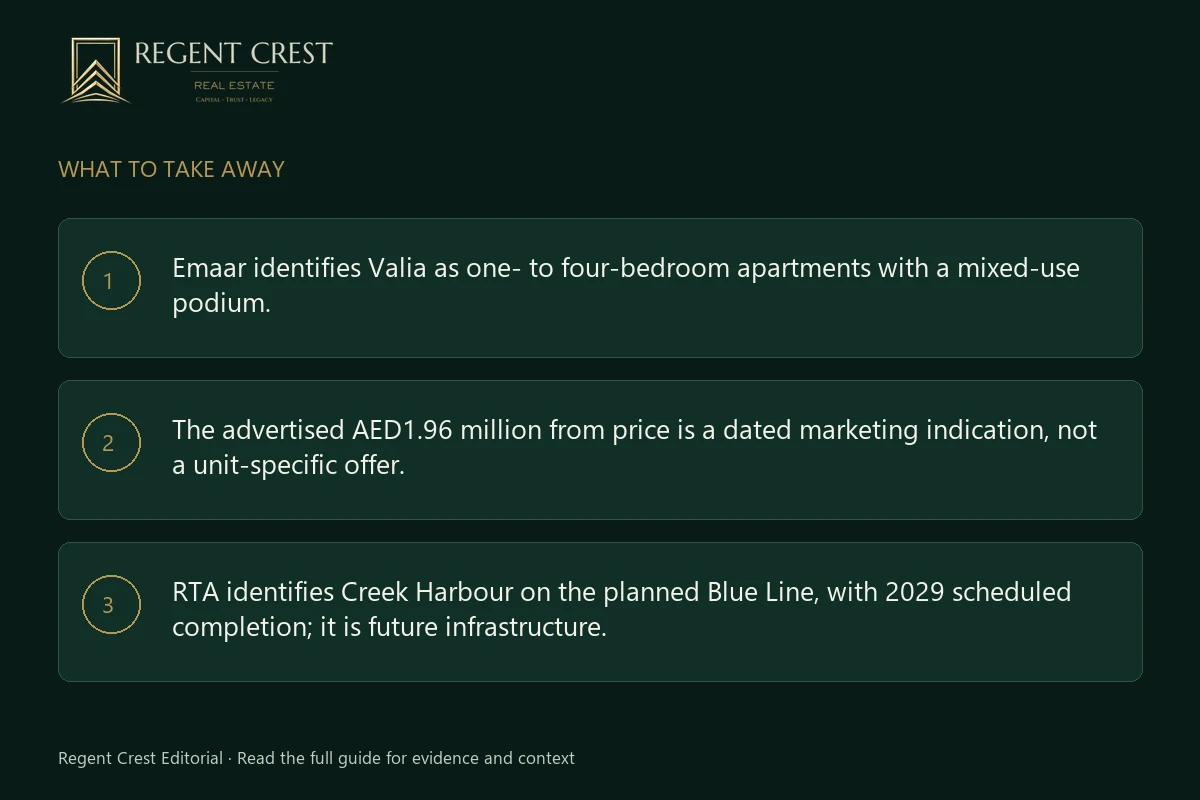
The official Emaar project page identifies Valia at Dubai Creek Harbour as a high-rise apartment development with a mixed-use podium. It presents one- to four-bedroom homes and displays an advertised starting price of AED1.96 million at the time checked. That is a published marketing indication, not a unit-specific offer or assurance that a particular layout remains available at that amount.
The direct answer for a buyer is to assess Valia through three connected questions: does the apartment work, does its immediate setting suit the occupier, and is the financial commitment comfortable on the actual delivery timetable? The planned Blue Line adds relevant context, but should be assessed as future infrastructure. Neither the community proposition nor the starting-price label settles the value of an individual unit.
Begin with the life inside the apartment
For a one-bedroom home, ask how living, dining, working and storage fit together without making every activity compete for the same corner. A separate study area may matter more to one person than a larger entrance. Another may need a kitchen arrangement that supports frequent cooking. Put the furniture you would actually use onto the plan. It is much easier to notice an awkward relationship before purchase than to solve it through expensive custom furniture afterwards.
For a larger apartment, examine privacy as well as room count. Are bedrooms placed where different household members can keep different schedules? Can a guest use a bathroom without moving through a private part of the home? Is there a practical place for laundry and the belongings that do not appear in a presentation image? More area can improve comfort, but only if it is arranged in a way the household can use.
Compare plans at the same scale and request dimensions where the drawing is unclear. Total area does not reveal how much space is spent on circulation, how deep a living room is or whether a bedroom has a useful uninterrupted wall. A family may prefer a slightly smaller home whose rooms work well over a larger plan with a difficult arrangement. That preference can be sensible even when a simple price-per-square-foot table suggests the opposite ranking.
The podium is part of the address
A mixed-use podium can place everyday activity close to residents. It also makes the relationship between public movement and private arrival worth studying. Ask where residential entrances sit, how visitors arrive and how the route from parking reaches the lifts. A lively setting can be attractive without requiring every home to experience it in the same way. The unit's position and the building's operating arrangement deserve separate attention.
Consider what happens around the home during different parts of a day. A person working remotely may care about activity near a particular frontage; someone out throughout the working day may value it more in the evening. Ask what uses are planned immediately below and opposite the unit, and which details remain subject to later delivery. This is an enquiry about fit, not an assumption that one kind of frontage is universally preferable.
The daily route from apartment to street can be as revealing as the main lobby image. Think about carrying shopping, taking a child out and receiving a large delivery. Ask whether service routes and resident routes are clearly explained. These are modest practical questions, but they help distinguish a handsome architectural concept from an accommodation choice that will remain comfortable after the first impression has faded.
Views need a unit-specific description
Emaar presents outlooks towards the Creek, skyline and community landscape. The exact combination should be checked for each apartment rather than inferred from the most striking project image. Ask where the unit sits on the floorplate, what lies in front of it and how the view is experienced from the main seating position. A balcony-edge photograph and a view from inside the living room can tell different stories.
If the outlook is central to the price you are prepared to pay, understand the basis of its description in the relevant documents. Study neighbouring development parcels and ask about planned buildings where information is available. This article does not claim a legally protected view for any unit. The sensible approach is to know which elements are established, which are represented by the developer and which remain uncertain before attaching a material premium to them.
Outdoor space should be examined with the same care. A balcony can be a genuinely useful extension of the home or a smaller place for a brief view outside. Check its depth, access, privacy and any service equipment. Separate internal and external area in comparisons with other projects. A larger total area may include a different balance between the two, which should reflect the buyer's priorities rather than being treated as an automatic advantage.
What the Blue Line adds, and when
RTA's official Metro information identifies Dubai Creek Harbour on the planned Blue Line and gives 2029 as the scheduled completion year. That establishes relevant transport planning context. It does not make the line a current service or establish the final door-to-door journey from a Valia apartment to a buyer's workplace. The separate timelines should remain visible in both a household plan and an investment model.
Start with the journeys available now. Then describe the later rail scenario using the authority's current information, including any interchange the intended destination requires. Do not assume that a station in the community removes the need to understand the route between the building and the station entrance. Walking access, crossings and the final part of the destination journey still matter. A transport improvement is most useful when it changes a real routine in a way the occupier values.
The temptation is to put an exact future premium on that improvement. This guide does not do so. Measuring such an effect would require a suitable research design, comparison population and clear assumptions. A buyer can appreciate the potential convenience without claiming a guaranteed price response. The more grounded question is whether the property remains an acceptable choice if the household needs to use existing transport arrangements for longer than hoped.
Compare the community at two scales
At the wider scale, examine how Creek Harbour fits the household's work, social and family geography. At the local scale, look at the actual building surroundings and the routes likely to be used every day. An attractive community description cannot resolve a mismatch with a recurring journey. Equally, a household may willingly accept a different commute for a particular environment. The decision is personal, but it should be made with an honest view of the trade-off.
An apartment within an evolving masterplan also needs a phased understanding of convenience. Identify which facilities are operating, which are under construction and which are plans. Do not fill in missing dates from assumptions about another part of the community. Ask the seller for current information about the area relevant to the chosen unit, then verify material claims through appropriate sources. A map becomes useful when its different states are labelled clearly.
Reading the advertised starting price properly
An advertised from price can help decide whether a project merits further enquiry. It cannot establish the price of a home with a preferred floor, orientation or layout. Request a current written offer showing the exact unit, stated areas, consideration and payment timetable. Keep the date and source of that offer. If the advertised figure changes before publication of this guide, the research and project registry should be refreshed together rather than preserving a stale headline.
Compare the financial commitment over time. A payment schedule may spread the price, but the amount due on a particular date can still affect the household's liquidity. Include acquisition expenses, financing conditions where applicable and a separate allowance for furnishing and moving. For a prospective landlord, do not start the rental-income line before the property is genuinely ready to let. Precision in a spreadsheet should follow the evidence, not substitute for it.
The operating costs behind the lifestyle
An amenities floor can offer useful shared facilities, but owners should understand how the associated services are managed and funded. Request the basis of any charge estimate, what it includes and what may be billed separately. Ask about the distinction between building facilities and wider community services. The research does not assert a current Valia service-charge figure because an authenticated estimate was not obtained.
Think about which amenities will be part of ordinary life. A pool or exercise space can influence the choice when the household expects to use it regularly. A long list of facilities is less meaningful if the buyer cannot explain which ones matter. This is particularly important for an investor comparing two projects with different operating models. An additional feature should be assessed alongside its contribution to occupier appeal and the cost of maintaining it, rather than counted as a free extra.
What would a credible tenant choose?
Define the intended occupier before assuming demand. A single professional, a couple working partly from home and a larger family can value different aspects of the same building. Identify the rooms, storage, travel and facilities that support that household. Then compare available alternatives on the same basis. A prospective tenant will choose a home and a total living arrangement, not simply a developer's reputation or the most impressive community statistic.
Where rental evidence is used, check its date, property type and whether it reflects comparable homes. Do not copy a broad community yield into a model for an unfinished apartment without explaining the mismatch. A future rent remains an assumption until supported by an appropriate method, and the net result depends on more than the gross annual amount. Vacancy, management and ownership costs should remain visible rather than hidden inside an optimistic return label.
A ready alternative can clarify the decision
Comparing a future Valia home with an inspectable completed apartment can be helpful even if the buyer ultimately prefers the new project. The ready home reveals current condition and surroundings, while the future option may offer a preferred plan or different payment timing. List what can be observed and what must be accepted through documents for each. The comparison should make the type of uncertainty legible, rather than place both homes in one price column and treat them as identical products.
Our off-plan checklist provides a framework for the future-delivery side of that comparison. The premium-property buying guide helps examine quality and suitability, while the waterfront community guide broadens the location discussion. These are starting points for a tailored comparison, not evidence that any particular alternative is currently available.
A useful way to finish the shortlist
For each shortlisted apartment, write one sentence explaining why the layout works, one explaining the position and one describing the financial commitment. Then list the unresolved items that could change the decision. This makes it easier to ask targeted questions and to recognise when a proposed home is attractive but incomplete as a purchase case. If an essential answer remains unknown, the shortlist can stay open without forcing a premature conclusion.
Keep the comparison documents in their original dated versions. A later quotation can change more than the headline price: the offered unit, payment dates or included items may differ. Review those changes together rather than carrying a favourable feature from one offer into another. If several people are involved in the decision, use the same current plan so that everyone is discussing the same home. This is a modest habit, but it prevents many avoidable misunderstandings and gives a professional adviser a clearer set of questions to resolve before the household commits.
Valia has an official project identity, a published apartment range and a relevant connection to Creek Harbour's future transport plans. A good buying decision will still be individual. It should connect those facts with a home that functions well, terms that are understood and a timetable the buyer can manage. To compare current written options, send Regent Crest your preferred layout, budget and recurring journeys. Those requirements can turn an appealing project page into a practical conversation about a specific home.
Questions answered
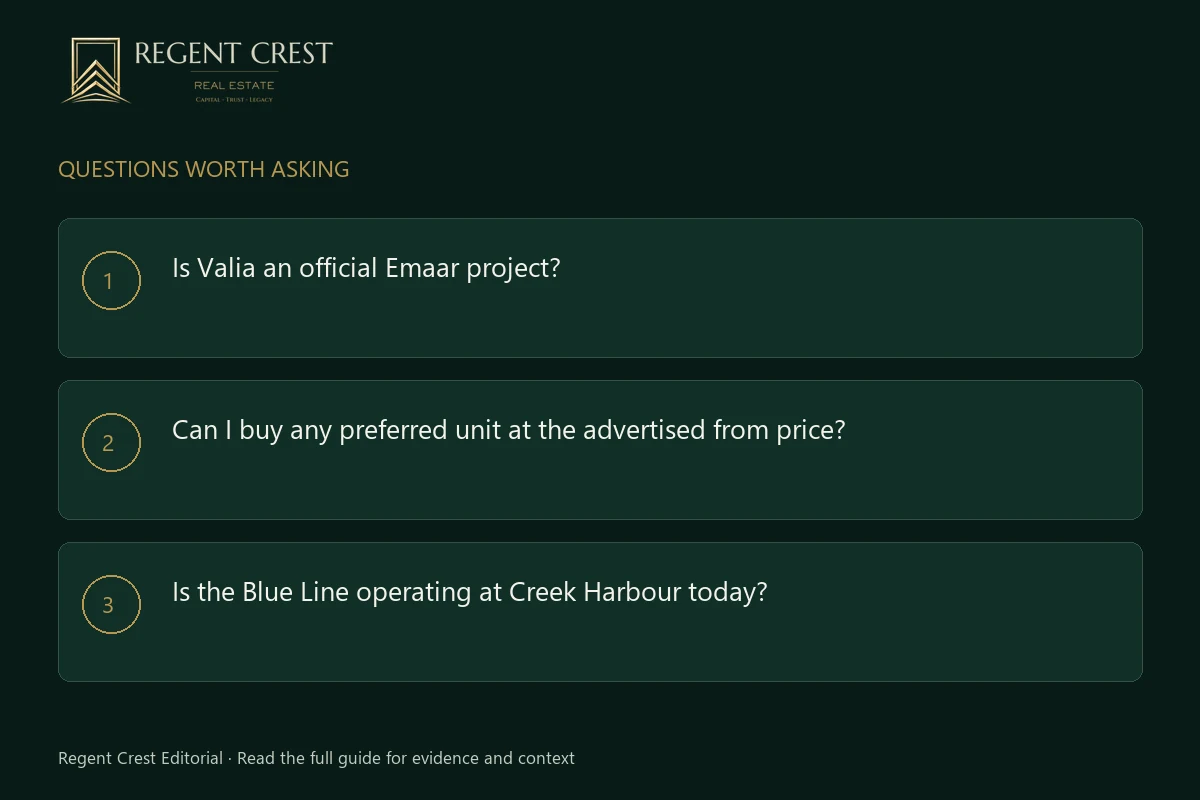
Is Valia an official Emaar project?
Yes. The official Emaar page identifies Valia at Dubai Creek Harbour and describes its apartment range and mixed-use podium setting.
Can I buy any preferred unit at the advertised from price?
No such assumption is made. The published indication must be refreshed, and a dated unit-specific offer is needed to establish current consideration and availability.
Is the Blue Line operating at Creek Harbour today?
The source used here describes a planned line with 2029 scheduled completion. Future transport should not be represented as a current operating service.
Does every apartment have the same view?
No assumption should be made from project imagery. Review the exact unit position, surrounding plans and the written basis of any view description.
Is a rental yield forecast provided?
No. A verified unit-specific rental and cost model was not assembled, so the guide does not invent a return for an unfinished home.
Sources and verification
Material claims last reviewed 22 November 2026. Availability, prices and project details can change.
- Valia at Dubai Creek Harbour — Emaar Properties · Checked 22 November 2026
- Dubai Metro official project information — Roads and Transport Authority · Checked 22 November 2026
Explore the relevant properties and communities
Apply this research to your property shortlist.
Share your budget, preferred areas and buying timeline. Regent Crest can help you compare the current options and identify the details to verify before you commit.
Discuss your requirement